Posted by: petertluce | February 22, 2010

Haiti Response Coalition meets at AUMOHD HQ

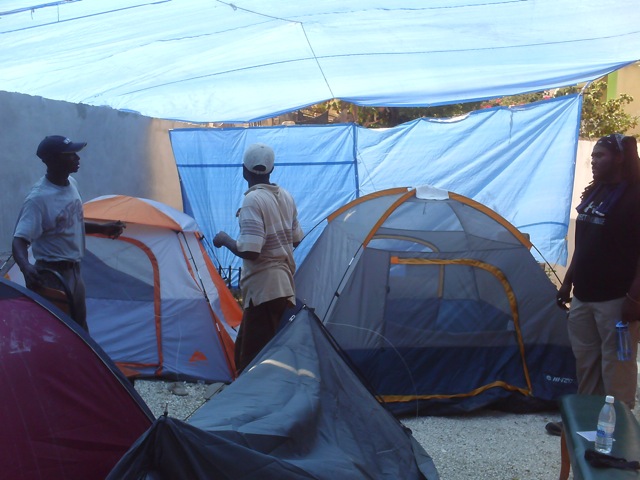
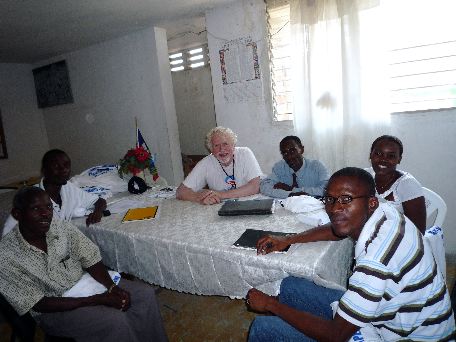
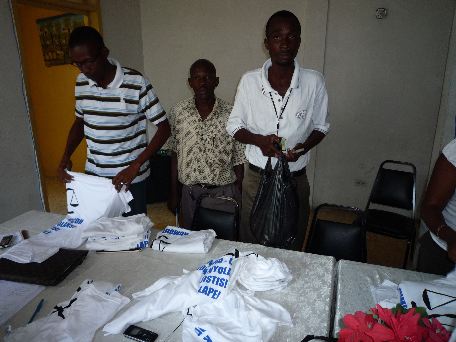
After a two-day retreat held at the Cannes à Sucre public park, the press committee of the Haiti Response Coalition (HRC) – a collaboration among Haitian progressive, social, and human rights groups  – met at AUMOHD‘s meeting space.  HURAH funds provided lunch and new tarps for the meeting.  Leading Haitian human rights lawyer Mario Joseph and Djaloki Dessables, long time Haitian-American promoter and HRC co-coordinator, were among the many attendees.

Press Committee Meeting at AUMOHD HQ

Press Committee Meeting at AUMOHD HQ

The HRC is designed to increase the influence of grassroots Haitian social justice groups over the decision-making processes of international relief organizations.  The United Nations and other relief agencies have created dozens of NGO “clusters” that are essential to getting services to those on the ground.  HRC will attempt to provide better access to these clusters.


Posted by: petertluce | February 20, 2010

HURAH visits Tent Cities for Internally Displaced Persons

Tent Cities – Not a Permanent Solution

HURAH visited several of Port-au-Prince’s tent cities, temporary home now to hundreds of thousands of displaced Haitians.  It should become clear from these photos that these camps are not a permanent solution.  HURAH is advocating for a massive civilian relocation project, and is working with several partners to to establish a new community at Galette Chambon in the countryside for at least some of these people.  Overcrowding in Port-au-Prince was overwhelming before the earthquake, and the quake has added new energy to efforts like HURAH’s Sustainable Investment and Human Rights in Haiti project (SIHRH).

Matthew 25

First up is Mathew 25, a tent city that is home to more than 1000 displaced Haitians.

Mathew 25 Tent City

Mathew 25 Tent City

Matthew 25 has a small field hospital (below), but no functioning toilets yet.  The International Lions Club provided most of the tents.

Matthew 25 Tent City

Matthew 25 Tent City Field Hospital

Of course, the dilemma is that the more that facilities are developed with amenities, the more likely its residents are to want to stay.  How do you provide immediate relief services to people in desperate need without encouraging permanent settlement?  Simply moving shantytowns from one part of the city to the other is not a long-term solution.

Alleyway in Matthew 25 IDP Camp

Alleyway in Matthew 25 IDP Camp

Pétionville Tent City – Home to More than 60,000 Displaced Persons

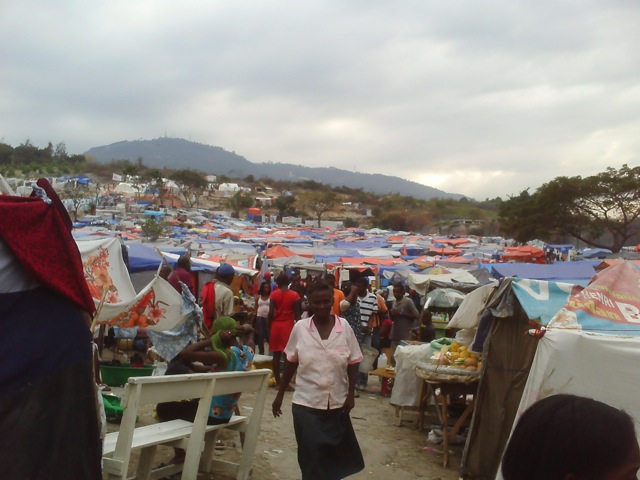
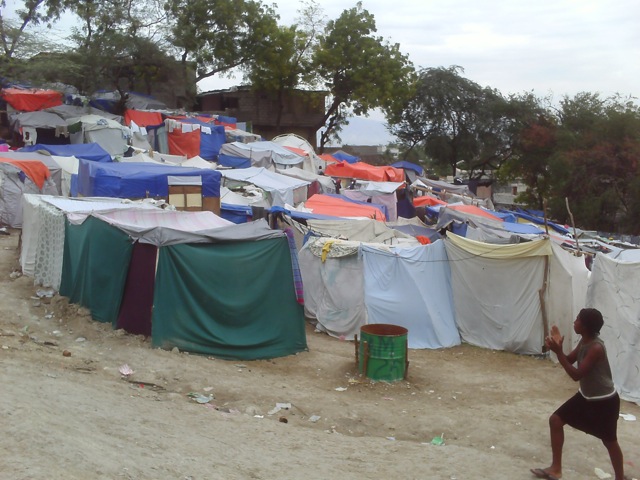
Next HURAH visited the tent city that arose on the grounds of the Pétionville Golf Club. This tent city grew from some of the first aid airdrops from the 82nd Airborne soon after the quake.  Built on a hillside, more than 60,000 people live here now.  These photos truly cannot convey the sprawling nature of this encampment.

Pétionville Tent City - 60,000 residents

Pétionville Tent City - 60,000 residents

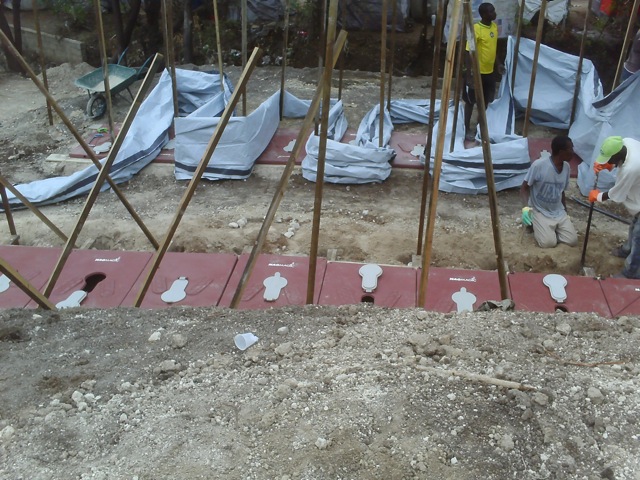
The Pétionville camp is run by Catholic Relief Services, and they have begun to install basic services like the latrines below.  However, the entire encampment is built on a hillside, and when the spring rains come, one can only imagine what the conditions will be like.

Pétionville Latrines

Pétionville Latrines

Hillside in Pétionville encampment

Hillside in Pétionville encampment

In spite of the conditions, Haitians are still able to manage to keep up their spirits, they have even built a cinema to distract from daily deprivations.

Pétionville cinema

Pétionville cinema


Posted by: petertluce | February 18, 2010

The AUMOHDmobile

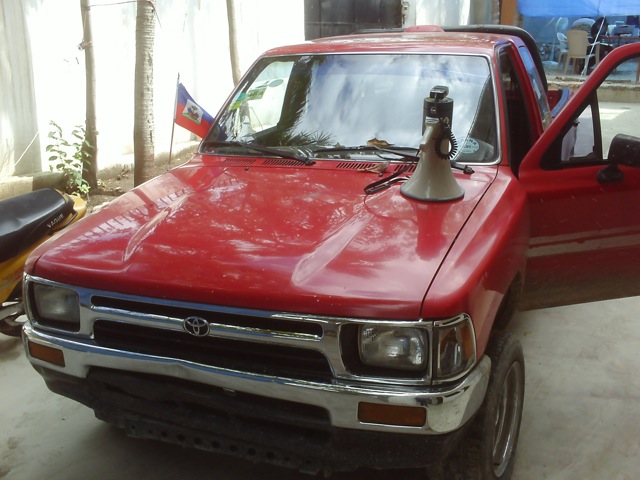
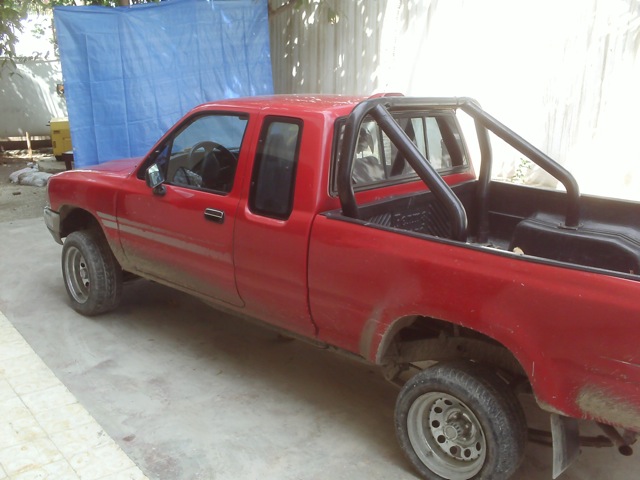
One of AUMOHD’s most pressing needs after the earthquake was transportation.  AUMOHD headquarters is located in mid-Delmas (49) separate from, but part of the capital sprawl of overcrowded city housing and burdened with end-to-end traffic and the crush of sidewalk vendors.  With cellphone service spotty and electricity non-existent, in order to effectively communicate with the various groups it supports, AUMOHD needed to be mobile.  The previous AUMOHD vehicle purchased with HURAH funds was destroyed in the quake. With financial support from HURAH, AUMOHD was able to secure this used, but beautiful Toyota pickup truck (the engine in this vehicle, the 1994 Toyota 22RE, is the most reliable gas-combustion engine ever produced, and should serve AUMOHD for years to come) .  Pictured also is the bullhorn AUMOHD President Evel Fanfan requested for use in addressing mass meetings.  HURAH President Tom Luce transported the bullhorn all the way from in Berkeley, CA.

The AUMOHDmobile, and the new bullhorn, purchased with HURAH donations

The AUMOHDmobile, and the new bullhorn, purchased with HURAH donations

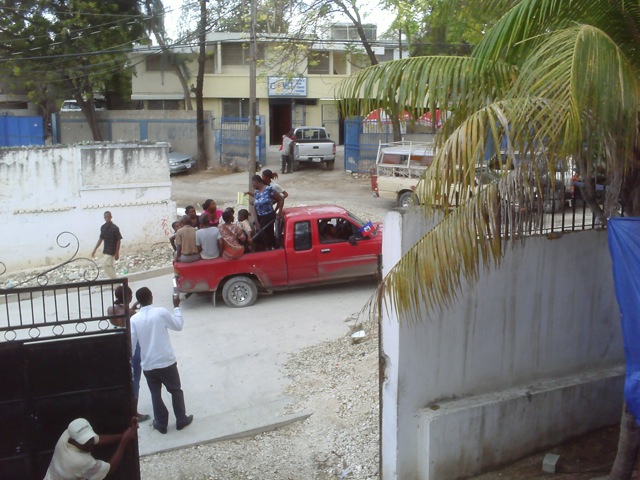
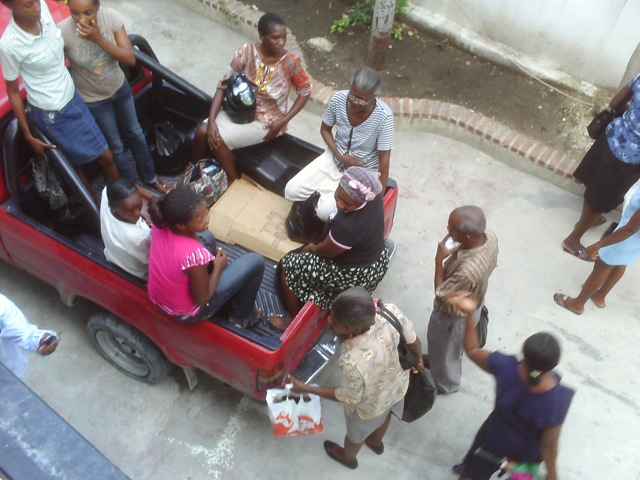
The AUMOHDmobile was put into immediate service, transporting women labor organizers from their homes all across Port-au-Prince to a labor rights training session.

Women labor organizers arrive for labor rights training meeting

Women labor organizers arrive for labor rights training meeting

Women labor organizers arrive for labor rights training meetingWomen labor organizers arrive for labor rights training meeting

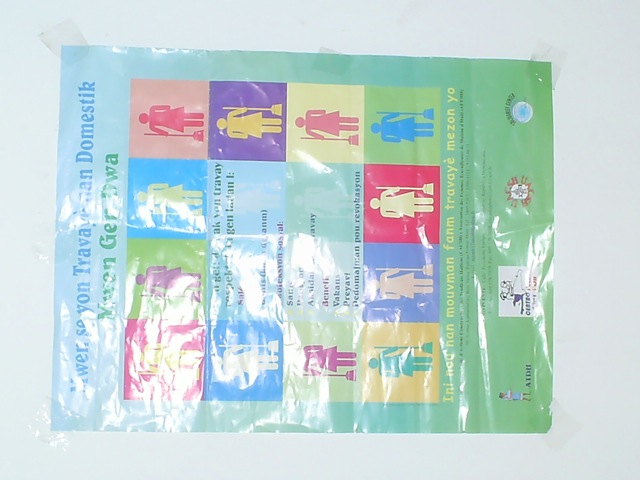
In partnership with ACILS, AUMOHD conducts trainings on labor rights for Haitian workers.  Sweatshops abound in Port-au-Prince, and basic labor rights are often ignored.  Part of AUMOHD’s mission is to educate labor organizers on their rights.  This poster hanging at AUMOHD headquarters depicts rights for domestic workers.

Domestic worker rights poster

Domestic worker rights poster

Here are a few more shots of the AUMOHDmobile:

Durable Bed liner and roll cage

Durable Bed liner and Roll Cage

Four wheel drive, and room for five passengers in the cab

Room for four passengers in the cab

Posted by: petertluce | February 17, 2010

HURAH: On The Ground in Port-Au-Prince

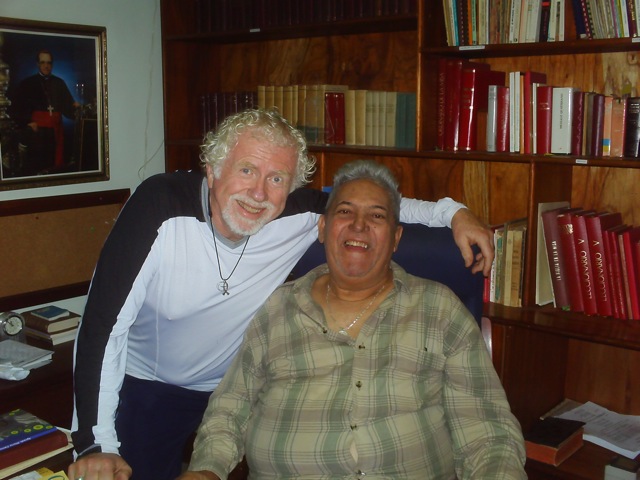
HURAH arrived in Port-Au-Prince via the Dominican Republic on Wednesday, February 17th.  Fr. Ricardo Santileses of the St. James the Apostle archdiocese in Santo Domingo, a seminary classmate of HURAH President Tom Luce, assisted in making travel arrangements to Haiti.

Tom Luce and Fr. Ricardo Santileses

Tom Luce with Fr. Ricardo Santileses of the St. James the Apostle Archdiocese in Santo Domingo

Originally the plan was to fly directly to Port-au-Prince, but many commercial flights have been cancelled.  The primary route into Haiti is over land through the Jimani Mountains.  Bus fare was $40 one way plus a $29 exit tax.

Haiti/Dominican Republic border crossing

At the Haitian border

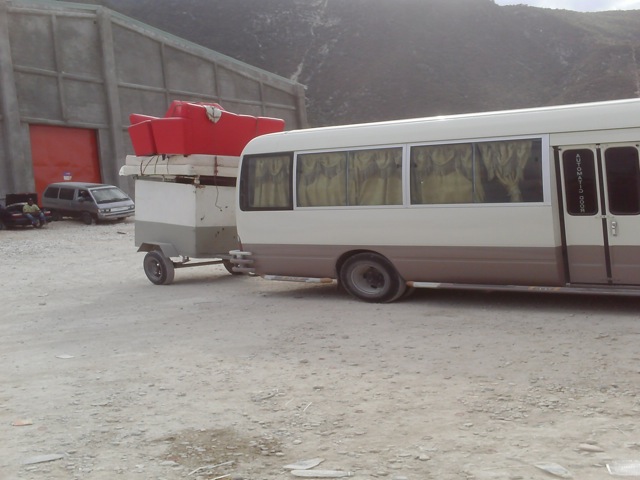
Tons and tons of relief supplies and materials pass through every day. Here is a bus with a trailer full of goods on its way into Haiti.

Relief Supplies headed for Haiti

Relief Supplies headed for Haiti

The earthquake damaged much of the interior of the country as well.  As you can see below, the tremors altered the contours of a lake near the Dominican border and submerged several houses on its shores.

Submerged houses on the shore of a lake in Haitian interior

Submerged homes

With no running water and only intermittent electricity from AUMOHD’s generator, alternative means for purifying water and cooking are required.  HURAH brought along this donated solar oven.

Solar Oven

Solar Oven for cooking and boiling water

AUMOHD’s headquarters in the Delmas neighborhood of Port-au-Prince, rented with funds donated by HURAH supporters,  survived the earthquake largely intact, and has become a hub of relief activity.  Its courtyards are now filled with tents, tarps and relief workers from several different groups, including members of the American Center for International Labor Solidarity (ACILS), an international labor organization affiliated with the AFL-CIO.

AUMOHD HQ Tent City

AUMOHD HQ Tent City

ACILS generously donated equipment to AUMOHD to replace the computers, printers and office equipment destroyed in the quake, shown here.

AUMOHD's outdoor office and tech center

AUMOHD's outdoor office and tech center

AUMOHD’s headquarters has become a “safe” zone for Haitian labor activists receiving organizational assistance  and tactical advice from ACILS.  Either they didn’t have offices before, or their offices were destroyed.  Labor representatives can come here to use the internet, telephones, printers, and copiers – all essential tools to organizing for worker rights in the aftermath of the quake.

AUMOHD President Evel Fanfan facilitating a labor rights meeting

AUMOHD President Evel Fanfan facilitating a labor rights meeting

The offices are secured by are wall surrounding the entire compound, and have quickly become a center for conducting meetings, organizing among relief groups, and providing shelter for Haitian and international volunteers.  Tom Luce ran into Michael Brewer, who has worked with Haitian street children for years, and to whom AUMOHD provides legal assistance.

Tom Luce and Michael Brewer

Tom Luce, HURAH president, and Michael Brewer of HSKI at AUMOHD HQ

Here are a few more photos of the AUMOHD compound and surrounding area – miraculous that it survived the quake at all when compared to damage to adjacent buildings.  An urgent fundraising need for AUMOHD will be next year’s rent on the facility, which will come due in a few months – last year’s rent was donated entirely by HURAH supporters.

Rear Courtyard and generator

Rear courtyard and generator

First floor meeting room

First floor meeting room

View from the front gate, AUMOHD headquarters

View from the front gate

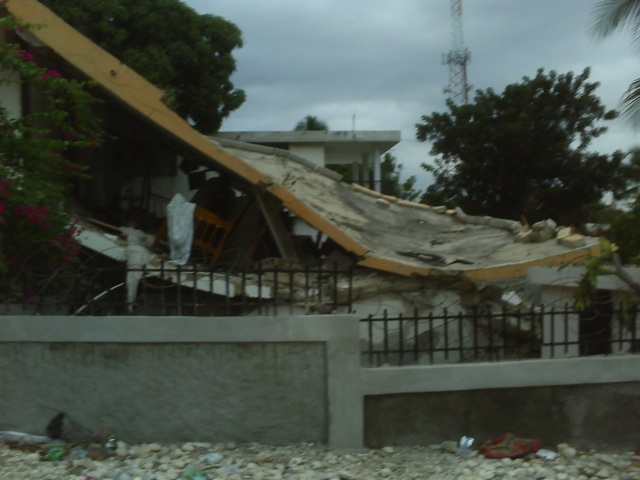
And now a few shots of some of the destruction in the surrounding neighborhood:

Collapsed home down the street from AUMOHD HQ

Collapsed home down the street from AUMOHD HQ

Why some buildings collapsed and others didn’t is a mystery.  Most Haitians are still afraid to sleep in buildings that survived, and for good reason – strong aftershocks are a daily occurrence here.

Remains of a bedroom

Remains of a bedroom

Vehicles were few and far between even before the quake, making functioning ones quite the commodity.  Up next: The AUMOHDmobile and a visit to one of Port-Au-Prince’s Tent Cities.

Destroyed vehicle in driveway adjacent to AUMOHD HQ

Destroyed vehicle in driveway adjacent to AUMOHD HQ

Posted by: petertluce | April 3, 2009

Grand Ravin Community Human Rights Council Meeting


I put this blog together in my head as I walked around the area taking pictures, getting money and attending a meeting on Friday.

What was on my mind is the controversy over home demolition here in PAP, specifically, last summer in Cité Soleil, and recently close to where I’m staying in Delmas 10 plus in Petionville.

It is reminiscent of home demolition in Gaza because it is the government bulldozing homes without any recourse on the part of the dwellers.

Some say that the government must have the right to take property for installing, e.g. a police and UN barracks (Cité Soleil). Some are upset that poor folks have broken zoning laws by building on the sidewalks and violating code regulations. There are those, and I naturally tend in this direction, that see this as a matter of social justice, 1)anyone is entitled to recourse and compensation; 2)the forced immigration of hordes of poor from the countryside into the cities was only to cater to the monied class’s interests (ruining local crops and spawning sweatshops in the cities).We did issue a complaint last year, but have not been involved in this year’s actions.

Our car broke down as it went to get me at the airport Thursday, not for the first time. That’s why I’m documenting the road conditions a bit here as the basis for having to mount a campaign to buy another automobile.

As I walk around the ‘hood and live the life of ordinary folks, I certainly can identify with the plight of the poor. Houses on top of one another, absolutely no open space. Pictured first left above is the street where I live. Next down is a fairly common washed out street which we have to navigate everyday to get to the office. Next is the water trough–no running water in any of these dwellings. Cold water bird baths are what we have to give ourselves. Electricity is on now almost every day for a couple of hours, a little more on Sunday. But then it comes and goes without notice. Our push for solar energy has made us self-reliant. (See further in this post.) And tonight the next door neighbor has started up the noisiest electric generator I’ve ever heard. I can only hope it will shut down so I can sleep.

And back to the theme of fear. It’s really so true about the worst fear of all is fear itself. I said I was beginning to fear being here–due to lack of being in touch mainly and listening to the bad stories–but now even though conditions have probably not changed all that much, I’m not afraid. Today we–an AUMOHD person– walked to the bank, about 15 minutes through the elbow to elbow crowds on market streets and we walked back with a bunch of cash, split between the two of us. This person shrugged off the idea that there might be a problem but he went along with my idea of splitting the cash so that we might save at least half of it in case of a heist or kidnapping (I’m really not hysterical, believe me.) It was pretty hot and crowded as usual. But everyone was so civil and responsive to my “bonjour”.

The culmination of the day was meeting with 3 reps from the Grand Ravin CHRC, Marc-Lucann Ducasse, Patrick Estimphil, and Jean Ernest Point du Jour. Marvelous, thoughful persons with the same dedication and skill and concern I’ve seen consistently with the Grand Ravin and other CHRC’s. These are experts without the credentials in non-violent justice advocacy. If only we could get a smidgin of the funding that so many other undertakings receive. I’m thinking of the USAID funded operations for weapons and defense for one example. These men recounted the numerous shootings of innocents just in the recent past and how they are still succeeding in negotiating with armed men to cease the violence. They were very happy with the justice Tees I brought. They want visibility to help them be recognized and respected. They are ready to open an office for which we will be donating the first CHRC solar powered communication system.

Finally back home Saidel, Evel’s brother and the techie among us went at the new solar equipment donated from Namaste Solar–Stephen Kane co-owner. I was able to read the manual and find out at least for my amateur mind what it was for. It’s called the “Booster” and by that they mean it captures energy, conserves and distributes energy from solar panels in a much more efficient manner. That’s good enough for me.

We’ve been using a tiny (red box in the picture) “inverter” and jury-rigged (is that just for nautical makeshift?) electrical connections. The solar power is still outlasting the public utility power even though it is on more regularly than when I first was here.

It’s now 10 pm and the devilish diesel electric generator which came on right under my window around 6pm is relentessly banging my eardrums. Will I ever sleep? Do we take out a suit against the neighbors for noise pollution–and air pollution? Do we go over and smash it? Maybe they would be marvelling at our silent and free solar system and would gladly buy their own!

Posted by: petertluce | April 2, 2009

Haiti Visit 2009


April 2, 2009 – Back in Haiti after 16 months. Weird feelings were bothering me leading up to this unexpected (due to lack of funds) trip. I actually was beginning to feel anxieties about my safety. My guess is that this is what happens when one is not grounded, in touch, present to a place and its people after an absence. Feelings can be misleading, if well intended as a protective device, but I’m here to say that the feelings now flooding my psyche are positive, grounded, in touch, enjoying the grasps of the real people, the real place. Yes, the US State Department warns people not to come. Yes, I’m here to continue working on the violence done against innocent people. But now instead of feeling frightened, I’m bolstered in my faith in humans again, because of the incredible (until you’ve experienced it) soulful, deep feeling Haitian people. It is part fantasy, sure, but the banner greeting me at the airport, “Haiti has been looking forward to seeing you”, started it all.

The trip from the airport is typical Haiti, cars bumper to bumper on narrow, deep rutted, unpaved streets. But I don’t experience the road rage with honking horns back home. People just keep moving. A man walks the narrow space between the opposite lanes selling something for the thirsty (below right).

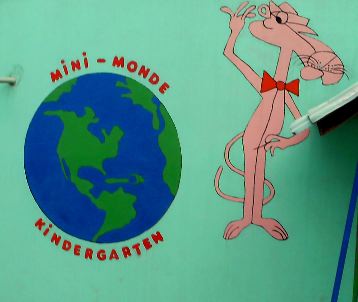
I see people walking the streets, unafraid, focused on getting somewhere, looking alive. Then comes the cute artsy walls of a kindergarten to charm us all.

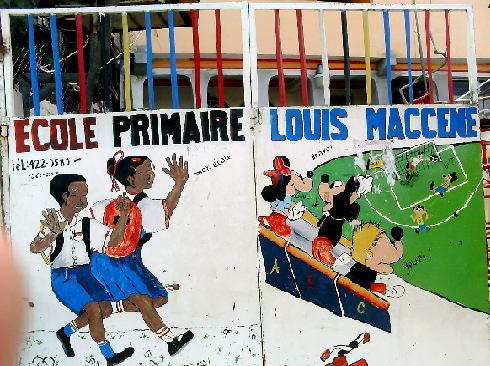
And another preschool painting on the street where I will live for two weeks. I’m feeling “back home”, a place vibrant with trucks filling water tanks that people come to for house water because there isn’t any running water, with kids playing in the street because it’s “Easter” vacation. I know that vast numbers of children don’t have access to good education but I’m here to be with people who suffer this and yet have a will to advocate, non-violently, for this right.

The neighborhood comes alive when the public power is turned on (typically for a couple of hours). I can continue working on this blog because we have a solar powered system, another richness of Haiti. And at 9:38 the “EDH”, public power goes away. And the first mosquito buzzes me. Not something that happened often before. Out with the mosquito net!

Posted by: petertluce | November 21, 2007

Celebrating Our Work

At the end of a long day on the last day of my working trip with AUMOHD we gathered to celebrate. Milka, Paul, Moïse, Evel, me, Issa (and photographer, Gentilhomme).

“EpiDor” is place on our main thoroughfare (Delmas) near the office, near home, and it is a fast food place with a difference. The name I think comes from the French or Creole meaning golden sword. Not really akin to the golden arches. The place has a little mascot that probably is a sword. In any case you can get burgers, chicken nuggets, salads, sandwiches, pastries. We bought a luscious strawberry cake to top off the celebration of the days in Cité Soleil, in Bainet, in Grand Ravin, and at the office and home trying to get our technology up to speed.

Just as we gathered we were visited by another neighbor, Moïse Jean-Charles, a well-known champion of the poor and human rights from the north and now working in the President’s office. What a nice reunion! I had worked with him in 2005 when he needed an international observer to help him convince the UN that the demonstration he wanted to hold concerning demands for a fair election would be peaceful and observed.

The water purification campaign continued last week with several more trips to Cité Soleil. Here is a picture of just one of the dozens of community cisterns where residents must come to get their water. Because of the vulnerability of these cisterns to contamination the campaign is designed to raise awareness of the need to purify water in the cisterns as well as in the containers that are brought home.

13+ different neighborhoods in the vast inner city section called Cité Soleil (300,000 people) were organized tightly in teams of 1-2 people who took responsibility for taking a seminar in water purification, for advising their neighbors, and for delivering Chlorox and Aquatabs for the actually purification process. Each area has 1-3 community cisterns with water pumps. The water needs purifying in the cistern and in the home as well as it is kept in containers. AUMOHD gathered buckets for demonstrating in houses the process of decontaminating and keeping it pure with covers. These neighborhoods are not in the center of Cité Soleil and were feeling abandoned by all the authorities and service groups. AUMOHD, our partner, worked hard (see my post earlier) to calm things down and bring the Mayor and the people together.

Here is a picture of the water purifcation seminar about to get underway. The leader is a member of the water commission and he volunteered his time. All the group leaders were volunteers as well, residents of the areas. This scenen captures the group in a beginning meditation and prayer.

As my 21 days drew to a close I was taken on Sunday, Nov. 18 to Musique En Folie, now in its 2nd or third year of featuring Haitian musicians and their CD’s It includes a festival of food and booths with many exhibitors including one for women’s rights and for services to alcoholics. Most of the crowd was young and laid back with lots of young parents with children.

Posted by: petertluce | November 17, 2007

A Life of Faith, Family, Community

This is a pitch for changing outsiders’ images of Haiti to one of normalcy, of faith, of family and warm community. The people are beautiful, gentle, and engaging. You should think of visiting here.

Those of us engaged in human rights struggles have by definition to expose unpretty scenes. And don’t forget, these scenes have their roots in the ugly practices people from the “first” world have brought here–slavery, dictatorship, terrorism.

There is even a concerted effort on the part of some criminals who benefit from a bad image for Haiti. There are those also who because they have been attacked personally send out messages not to come to Haiti. The stained glass window in Atty Fanfan’s home church is a beacon of faith and hope that inspires him and a huge congregation of 500 every Sunday at church. I’m suggesting that you think of Haiti as a majority of faithful, decent people. You would enjoy a stay here.

You should not hesitate to come. You should support the struggling tourist industry. There are suitable vacation spots, celebrations, film festivals, concerts. It will help everyone. Or come observe and/or work with some social change group and you will enjoy it.

I’m sitting here listening to a soccer game–the public electricity is on now and we have no problem keeping TV’s going. Sweden and Spain are playing and ordinary folk unlike us crusaders are crowded about TV’s everywhere. It is Saturday and people are out on the streets, crowding the lines at the banks, at the supermarkets, people just like us out getting what we need to keep home life going. Today it is the 8th birthday of Atty. Fanfan’s son, Meltary.

For the last week I have been out walking in the neighborhood, out to the main street, Delmas, to the supermarket, to the bank. This is an inner city neighborhood, crowded to be sure, narrow streets, packed with small merchants. Trucks actually can navigate these tiny streets. I prefer the country myself–where we were last Saturday in the mountains and then by the sea. But city life is exciting and stimulating, no doubt about that. People party here.

Here is a picture of Annie’s, downtown. Not a smoky bar with lots of noise. We went there because it is owned by a friend of ours and there was a nice, calm
birthday party being celebrated. Soft music filled the background. All young parents it seemed, some with babies and children. Nice time.

Walking on the streets is crowded. Especially when the street also is a place for small merchants who put their wares on the ground so that the already narrow street becomes even narrower. It is mind boggling how these folks make a living, hawking their wares.

Yesterday I witnessed something that was a stark symbol of how hard life can be here. A young man, medium size was hauling one of those huge carts–they remind of a chariot or a rickshaw–you know where a human is where a horse would be in other places. As I was coming down a steep incline he was coming up and he stumbled and fell flat on his face. His load was heavy metal scrap. Another man was pushing from behind. But they both had to stop and catch their breath.

Here is a picture of my neighborhood. All cement block houses. Some are decorated with filigreed railings. Life is very crowded with the houses close together. I imagine that there is a small city in just this immediate area–10,000 or more people.

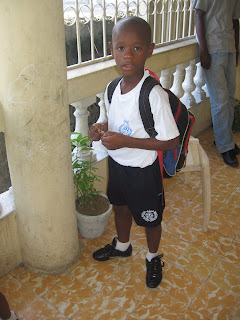
There is school here for those who can afford it. Universal education was a goal of the Aristide administration and more public schools were built here in his time than in the entire history of the country. The access for everyone goal is a long way off. People like the superstar rapper Wyclef Jean make a lot of collecting money for scholarships, but the system is simply not designed for everyone. But I’m back on my human rights kick. Enjoy these two school pictures of our partner’s children.
SOLAR POWER

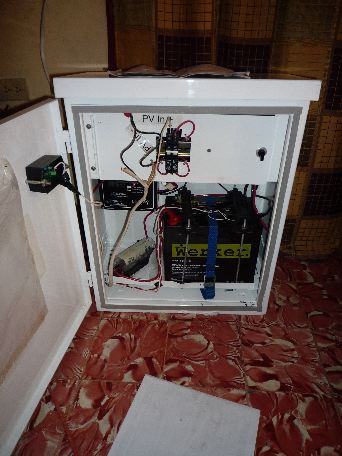
O.K. here is a mundane, but environmental friendly piece of our life here. Sun is abundant here and I’ve tried valiantly to make the sun work for us. It has been slow and has had its moments of doubts. This visit I found the system: 2 – 80 watt panels, a charge controller, an inverter and a bank of 4 batteries– had been aging and that was the reason communications had been diminishing. Solar power is great but it, at least in my experience, is fickle, not just the sun hiding, but the electricity in the batteries can tend to come and go. You think you’re set for working on the computer and “wheeeeeee” the inverter screams it is low on power. So you unplug and some times even that doesn’t fix things. The inverter we purchased new is now headed for the cemetery. We went out and bought a small Vector MAXX 400 watt-800 max jobby that people sell to truckers or others with batteries to run appliances. This actually works as well as the professional one we are throwing away. Go figure.

Then there is the internet hook up. At first we installed a satellite dish. It worked pretty well, but not during the rain. And then we discovered the “magic box” approach to catching the internet. This is a little portable wireless broadband receiver that you can put anywhere or carry it with you to different places. It connects to your computer or wireless router and you’re plugged in. Trouble was this first “magic box” ($100 purchase, $50 monthly fee) didn’t have a strong signal. So we had to find a new company (Hainet) recommended by a friend who does a lot of journalism uploading. It cost another $100 ($60 monthly fee), but it is fast and efficient. There it is being protected in our hallway by the stuffed animals!

Here is Delmas, 32 block, a huge main thoroughfare connecting from the bay to the mountains outside of Port-Au-Prince. We live quite a ways up and far away from the city center. This is the local supermarket. Just like home. And people out doing their Saturday shopping–those who aren’t watching soccer.

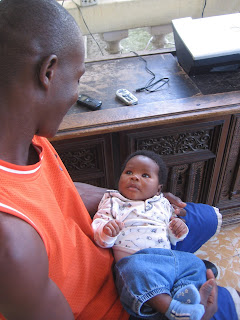
Finally there is family. Here Uncle Saidel keeps 2 mos old Melgore happy while his parents are out. He is an extremely calm, happy baby–except when he is awake and left alone.
Posted by: petertluce | November 14, 2007

A Crying Shame – Street Kids Robbed Of Home

This gutted building once housed a few hundred kids rescued from the streets of Port-Au-Prince by Fr. Jean Bertrand Aristide in the 90s and into the new century. It was called, Lafanmi Selavi (Family Is Life).

The fate of kids driven to the streets by poverty, abuse, or death back in the Duvalier dictatorship days was not only street violence, but, not unusually, extermination by paramilitaries. “Cleansing” the population was the way these utterly depraved men described what they were accomplishing. Fr. Aristide signaled the end of such treatment if he could have any say in the matter. A crying shame.

That human beings, let alone young children, could ever be treated this way is not the only shame. Almost as soon as the doors were opened back in the 90s, enemies of Aristide’s social programs began plotting to keep this home from becoming a beacon of hope for the poor. It was attacked and damaged. Outsiders plotted with some residents to overthrow the home and denounce it as a bad place for kids. Subsequently these same kids confessed to the ruse.
Finally in Feb. of 2004 the place was closed for good. Then President Aristide was kidnapped by the US government in a ruse to protect him from a “popular uprising”. In fact it was a small band of mercenaries who went on a rampage with powerful CIA-derived weapons in the north, killing innocent people. Lafanmi Selavi, the home for street kids, already virtually closed, was further ransacked after Feb. 29, staff beaten, and left abandoned.

One of the residents of Lafanmi Selavi was Reagan Lolo who was driven to the streets by family violence at age 11, but was soon rescued by the Aristide staff. He prospered there and became nationally known for his news commentary and disc jockey work at the Aristide Foundation’s Youth Radio and TV station.

When the last coup brought down Pres. Aristide in 04 and thugs began attacking the home, Lolo, now living with friends and finishing high school, went to its rescue, put street kids back in, recruited adult volunteer caretakers, and put up barricades. After a few weeks the police arrested Lolo without any warrant and clamped him in prison where he languished for over 3 months in jammed cells, eating infested food and drinking contaminated water.

An honest judge threw his case out but to no avail. The justice department under the control of the illegal interim government of Gerard Latortue (a US supported measure) did not respect such orders regarding anyone connected with Pres. Aristide.

On June 25, 2004 through the dogged efforts of Atty. Evel Fanfan, President of AUMOHD a Haitian human rights, non-violent/non-partisan, advocacy group, Lolo was freed from prison, a first for the partnership of Hurah, Inc and AUMOHD.

Now Lolo is continuing to work on his dream of working for street kids by laying a solid foundation for the revival of Lafanmi Selavi. He has been elected among his peers from the former residents as coordinator of the team to bring Lafanmi Selavi back to life.

Lolo has already formed a community organizing project.

Here is a new kid, amazingly young, hanging out at the old Lafanmi Selavi and part of a group of 20 invited by Lolo and his committee to consider forming a “family” in his old home. There are substantial parts of the building left where a classroom, a storage room and living quarters are slated to be made permanent. Beside the structural difficulties that need to be rectified there are the problems of ownership, and vagrants who consider this their territory. But Lolo and his committee are working carefully with the authorities and with AUMOHD to get this groundwork taken care of as they look for funding.

Here Paul, a volunteer, Lolo, Tom Luce, and Patrick a former resident and member of the steering committee stand out front of the home. The sign was for the now closed women’s health clinic that came in after the home was ransacked.

Posted by: petertluce | November 11, 2007

Community Human Rights Council Launched At Bainet-by-the-Sea

Leaving the capital of Port-Au-Prince for the south east provides breathtaking beauty of the mountains Haiti is famous for. But 10 hours (coming and going) on washed out dirt roads to give 4 hours of a seminar on human rights has to take the prize for dedication to a cause.

We were squeezed 4 in the back and two in the front of our land rover which proved a good match for the at times mud pools and deeply rutted steep hills. Breathtaking beauty just the same and a totally different world from the teeming capital.

The winding and roller coaster hill roads pass through rock walls with many tumbled down rocks, through a couple of rivers. It is amazing to see that people actually live and apparently are at home here. The temperature is more pleasant. The hills are verdant. Lots of corn growing. Many beasts of burden used for transportation as well as mopeds.

Bainet is a sea town (78,000 pop) in the south east near the more famous cinema festival town of Jacmel. We went there at the request of friends and families of an AUMOHD volunteer lawyer, Bainet-born Atty. Toussaint.

Bainet probably was a quaint resort town back in the days of the Duvalier dictatorship–you can see the beach is only attractive to the donkeys– but now seems to be pretty hard hit by all the ills of Haiti’s hard times.

In looking up this town on Google I found several organizations dedicated to improving the quality of life there–schools, clinics, etc. The town celebrated its patron saints, Peter and Paul, this past summer in a huge celebration that included all sorts of dignitaries, politicians, UN personnel. It sounded like a huge and important celebration. But I read nothing in the report about human rights and the needs of the people, just the merits of following in the footsteps of Peter and Paul. Still, given all the panoply of the church and political presence in this place, I had to wonder whether our outreach was really needed.

The people of Bainet had heard about the model of a Community Human Rights Council (CHRC) which AUMOHD has been building in 4 of the inner city zones of the capital from Bainet native and AUMOHD volunteer lawyer, Atty. Toussaint. They wanted to gear up to advocate for their rights with this model apparently because they didn’t feel recognized or empowered to work for them. To judge from the attendance (50+), the attention span, the questioning, the signups for follow-up, the CHRC model has a lot of credibility.

Atty Fanfan presented a thorough study (with a handout) of the refinements of human rights citing international documents as well as the Haitian constitution of 1987. He received lots of heads nodding in agreement about the difficulty of establishing and maintaining a state with respect for human rights and that a new model was needed–non-political, non-violent–to move forward with an improvement in the lives of people in Haiti. His talk with a question period lasted over an hour.

Atty. Toussaint went into more detail with definitions and case examples (with handouts) in the advocacy for human rights during another hour presentation with questions.

Everyone was attentive, asked pertinent questions including “Atty. Toussaint, how can you explain the fact that Pres. Bush pushed for the death penalty of hanging for Saddam Hussein, if this is against international human rights pacts?”

More than 8 different sectors signed up to form the new CHRC–clergy, school professionals, community activists, women and young people reps. There were no politicians or political party people in attendance and it was clear that the purposes of the CHRC model were not being met by existing organizations.

AUMOHD is obviously fulfilling a felt-need. There was no charge for this service–as is the case for all its services–but there are costs involved, namely, transportation (including wear and tear on the vehicle) printing, and food.

Think about helping AUMOHD by contributing through GOOGLE on our website. Google no longer charges non-profits!!!

« Newer Posts - Older Posts »

Categories